Understand what connects an order to a visit
An order may carry a direct cart identifier, a checkout token, a recognized customer signal, or a landing-page URL. WeProfit uses the available evidence to link orders with the journey that preceded them.
Confidence labels such as exact, strong, inferred, and none help explain that association. Stronger source evidence is different from a promise that an ad caused a sale. Read the label before treating every attributed order as equally certain.
| Label | Evidence used | Boundary |
|---|---|---|
| Exact | WeProfit visitor or session identifiers carried into order cart attributes | An exact visit link may still lack a campaign or ad ID. |
| Strong | Matching checkout token, relevant order-page URL or hashed email associated with a recent visitor | The matching method is stronger than a landing URL alone; it is not a causal claim. |
| Inferred | Campaign parameters or click identifiers in the order’s landing URL without a visitor/session link | Order-level source context, not a recovered browsing history. |
| None | No qualifying link established from the available signals | The order remains untracked for attribution. |
One order, different possible evidence
Illustrative example only: a shopper arrives from a Meta ad with utm_campaign=summer_launch, wpcid=123, wpasid=456 and wpadid=789, then places a $75 order. These are invented values, not customer results.
If cart-carried WeProfit visitor/session identifiers reach the order, the link can be exact. If those identifiers are absent but an identified checkout event shares its checkout token, the link can be strong. If only the order’s campaign-tagged landing URL survives, the source evidence can be inferred.
These are alternative linking paths for one order. They are not three purchases, and none of the labels proves that the advertising caused the purchase.
Add the details needed for campaign reporting
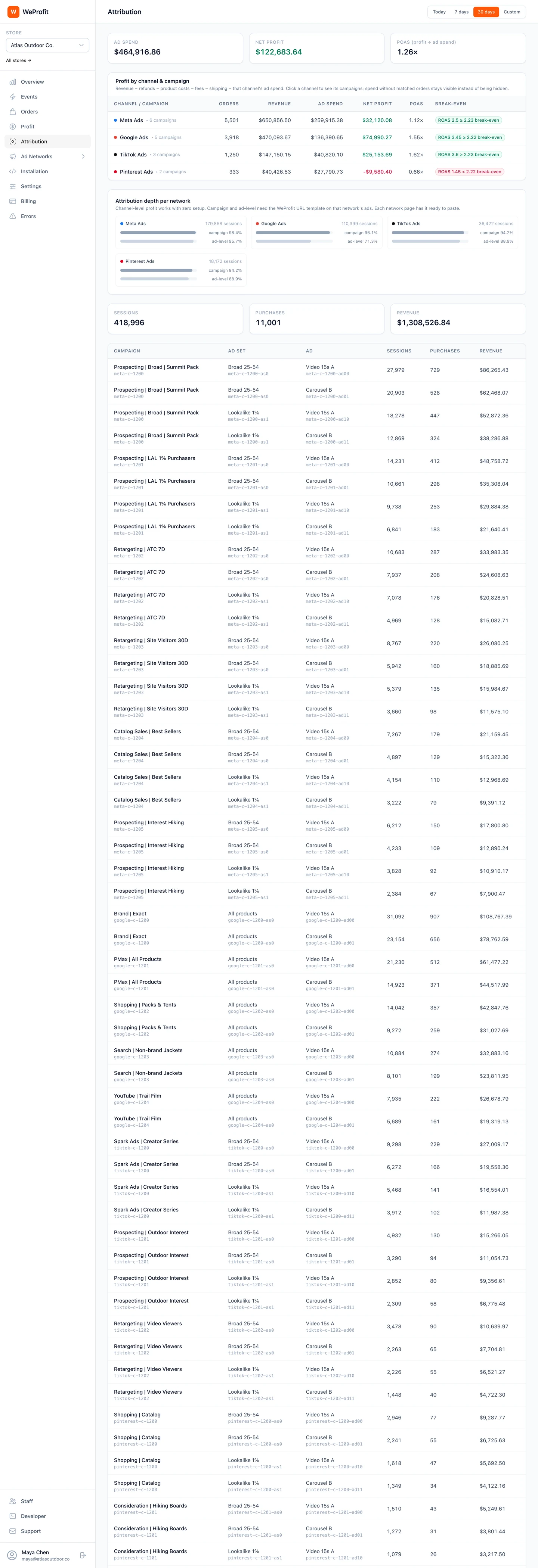
Channel-level information and campaign-level information are not interchangeable. WeProfit campaign, ad set, and ad detail requires the appropriate WeProfit URL templates on your ads.
Apply those templates as directed in the dashboard. Preserve the tracking parameters through landing-page redirects so the collected visit retains the information needed for reporting.
| Parameter | Meaning |
|---|---|
| wpcid | Campaign ID |
| wpasid | Ad set or ad group ID |
| wpadid | Ad ID |
| wpplc | Placement |
| wpsrc | Source platform, where supplied |
| utm_* | Readable source, medium and campaign context |
Compare attributed outcomes with the spend behind them
WeProfit supports automated spend synchronization for Meta, Google Ads, TikTok, and Pinterest. Conversion delivery supports ten destinations, but that does not mean all ten provide automated spend imports.
Connect the relevant ad accounts and review equivalent periods when comparing spend with orders. Cost and revenue data then provide context for ROAS, POAS, and net profit.
Use attribution as evidence for a decision
Ad networks use their own attribution settings and may each claim credit for a purchase. Adding all network-reported conversions can therefore count the same store order more than once.
Use the store’s orders as a commerce reference, inspect collection and delivery when something is missing, and then compare attribution definitions. WeProfit’s evidence labels help explain its order matching; they are not selectable multi-touch credit models.
Meta campaign URL template
Copy the current template from your WeProfit destination settings into the ad’s URL parameters. Keep existing required parameters and avoid duplicate keys. Templates apply to new clicks; they do not reconstruct past campaign identifiers.
utm_source=facebook&utm_medium=paid&utm_campaign={{campaign.name}}&utm_term={{adset.name}}&utm_content={{ad.name}}&wpcid={{campaign.id}}&wpasid={{adset.id}}&wpadid={{ad.id}}&wpplc={{placement}}&wpsrc={{site_source_name}}Google campaign URL template
Use the WeProfit template in Google Ads Final URL suffix and retain auto-tagging. This template uses Google campaign IDs, not campaign-name macros. Check that landing-page redirects retain the resulting parameters.
utm_source=google&utm_medium=cpc&utm_campaign={campaignid}&utm_term={keyword}&utm_content={creative}&wpcid={campaignid}&wpasid={adgroupid}&wpadid={creative}&wpplc={placement}